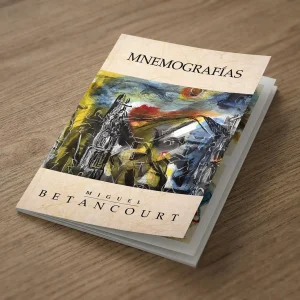
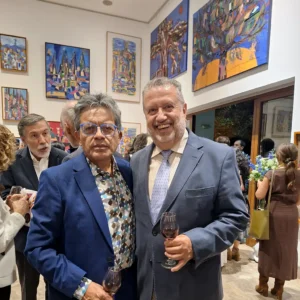
In September 2019, the Saladentro space in Cuenca became the epicenter of one of master Miguel Betancourt’s most personal endeavors: “Mnemografías”. This exhibition was the distillation of a accumulation of experiences, places, and silences that inhabited the artist’s mind until transforming into pictorial matter.
The Origin of the Concept
To understand the depth of this exhibition, it is necessary to refer to the words of curator and researcher Humberto Montero, who coined the term that titles the series:
“Mnemografías is an ideal neologism to approach the work of Miguel Betancourt. An architectural collection leading us to the author’s spatiotemporal memories and to that emotional heritage of the Quito historic center. (…) The neological value of the term mnemographic determines the writing of an immediate memory that the artist transfers into the aesthetic artwork.” — Humberto Montero
Translating Time into the Language of Art
In this show, comprising 40 pieces, the sites and spaces that “spoke” across time were translated into the master’s particular language. Betancourt utilized oil and watercolor techniques to link his perceptual memories to supports of vast visual identity: handmade papers and calligraphic inks from the East.
Innovation: The “Assemblages”
One of the major innovations of this exhibition was the presence of two sculptural “assemblages”. These pieces, arranged on rectangular modules, allowed the public to experience image transformations depending on their position relative to the glass and metal frame, which contained watercolors on silk paper attached by their reverse sides.
Encounter with the East
Following his travels through Asia, Betancourt incorporated materials from China, Japan, and South Korea. This direct contact with traditional calligraphies allowed the fusion of Andean essence with millennia-old creation methods, “mnemographing” an architectural order underlying the artist’s visual culture.